


Computing Science
Curriculum Intent
It is our intent for the Computing element of our school curriculum to engage, inspire, challenge and encourage students to experience a full, broad and ambitious programme of learning linked to the whole-school curriculum, the school’s CHRIST values, the National Curriculum and the changing needs of employers and society.
Our curriculum is designed to be a complex, creative and skilled experience in which students develop both theoretical knowledge and practical skills and apply them to increasingly challenging and authentic problems. From Year 7 to Year 13, students progressively learn to think, create, investigate and solve problems like computer scientists, programmers, cyber security professionals, data scientists and digital creators.
Students develop their knowledge and skills through explicit teaching, practical programming, investigations, problem solving, collaboration and independent projects. Learning is carefully scaffolded so that students progressively develop computational thinking, programming and debugging, understanding of computer systems and networks, data representation and analysis, cybersecurity and artificial intelligence.
Students are given opportunities to apply their learning to real-world contexts. They create digital products, develop programs and websites, analyse datasets, investigate cybersecurity incidents, explore artificial intelligence and consider the ethical, social and cultural impact of technology. Through these experiences, students learn not simply how technology works, but how it can be used responsibly and creatively to solve problems and improve people's lives.
Our curriculum is ambitious for every student, regardless of prior attainment or barriers to learning. Students develop resilience, creativity, collaboration, communication, critical thinking and problem-solving skills alongside their technical knowledge. Retrieval, questioning, modelling, practical application and increasingly independent outcomes help students to build secure knowledge and become confident users and creators of technology.
Students who complete our seven-year Computing curriculum will:
- Become confident programmers, developing skills in Python alongside experience of Scratch, EduBlocks, SQL, HTML, CSS and JavaScript.
- Understand how computers work, including how computer systems store, process and communicate information.
- Understand computer networks and cybersecurity, and be able to use technology safely, responsibly and securely.
- Work confidently with data, including investigating, cleaning, analysing, visualising and evaluating real-world datasets.
- Understand and critically evaluate Artificial Intelligence, including its opportunities, limitations, risks, bias, privacy implications and ethical considerations.
- Apply computational thinking to decompose problems, develop algorithms, create solutions, test and debug programs and refine their work.
- Create and evaluate digital solutions through authentic projects, investigations and real-world scenarios.
- Communicate technical ideas effectively, explain their thinking and justify decisions using appropriate Computing terminology.
- Understand the impact of technology on individuals, society and the wider world, developing the knowledge and judgement needed to become responsible digital citizens.
- Develop the knowledge, skills and confidence to progress into Sixth Form, further education, university, higher apprenticeships and careers across Computing and the wider digital economy.
Through this seven-year journey, students are prepared not simply to use technology, but to understand it, question it, create with it and use it responsibly.
This enables our students to live life in all its fullness by developing the knowledge, skills, confidence and curiosity to participate successfully in an increasingly digital society and to become confident, capable and responsible digital creators and problem solvers.
Curriculum Plan
KS3 Learning Journey
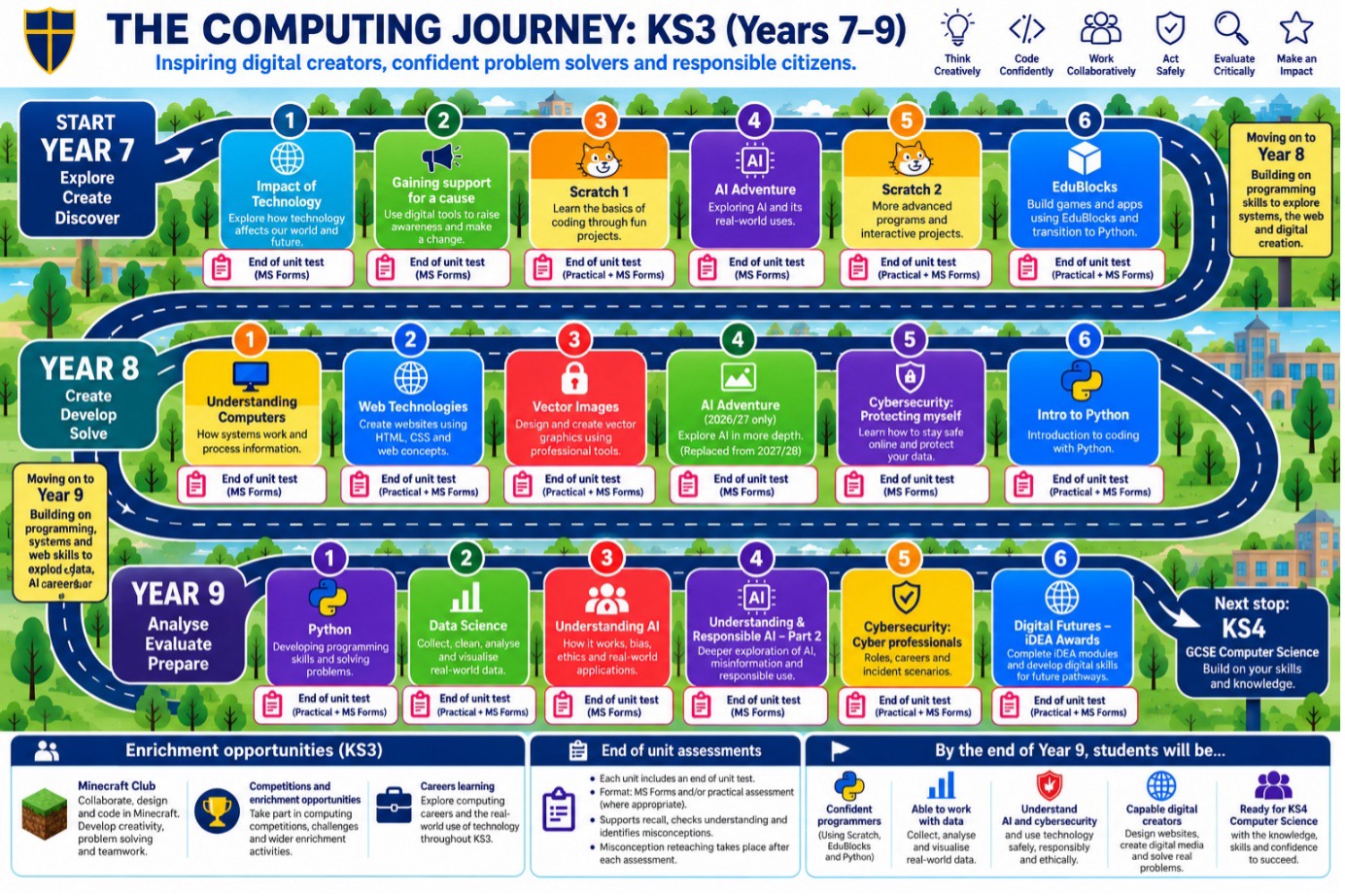
KS4 Learning Journey

Teaching and Learning
In Computing, we deliver an ambitious, inclusive curriculum that ensures all students access the full breadth of content. Our teaching vision focuses on high expectations and embedding the 3Rs: Ready, Respectful, Responsible. Lessons follow the school’s Blue Coat approach; explaining and modeling, do and practice, and using the 4forAll Toolkit: key words/reading, time management, chunking/checking, questioning, and providing appropriate verbal, written and visual feedback. Reading is a key strategy, with staff using “Jump In,” the “3-Second Rule,” and “Echo Reading” techniques to support learning.

How can parents help?
KS3
BBC Bitesize – Link
Teach Computing – Link
GCSE
Isaac Computer Science – Link
Craig ‘n’ Dave – Link
A Level
Isaac Computer Science – Link
Maths and Physics Tutor – Link
Craig ‘n’ Dave – Link
Options
- OCR GCSE Computer Science
- OCR A level Computer Science
Enrichment & Experiences
Extra-curricular activities
- Monday lunchtime – B9: Year 13 Computer Science NEA support
- Thursday after school – B10
- Year 11 GCSE Computer Science support – 3.15–4 pm, DKE (start date to be confirmed)
- Friday lunchtime – B9: Minecraft Club


